← back to work
01Product / AI
Investor Intelligence Database
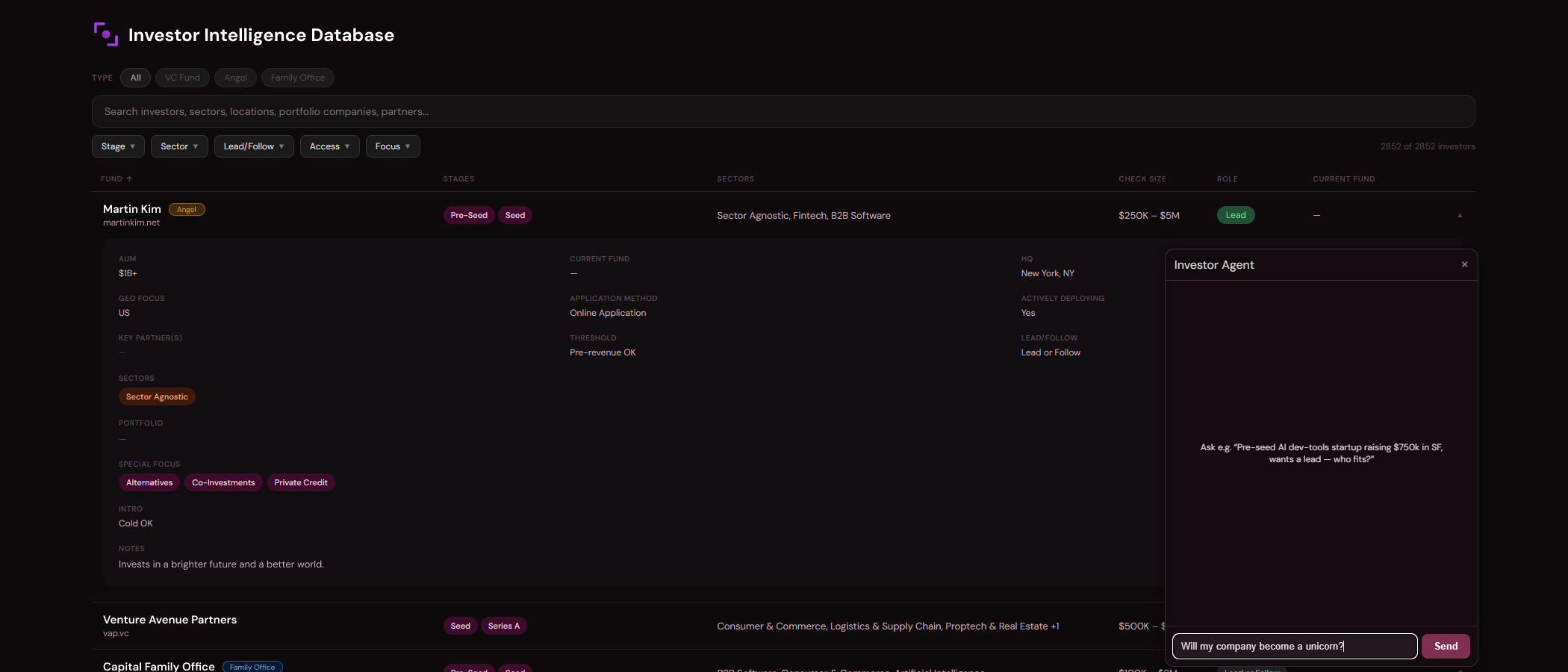
An automated data pipeline and matching engine tracking 2,000+ active funds, family offices, and angels — cutting investor targeting from days to seconds.
- Role
- Head of Product & Ecosystem
- Year
- 2024
- Client
- LvlUp Ventures · FundBetter
- Stack
- Rust, SQL, AI agents, Airtable
2,000+
investors tracked
days → seconds
time to match
AI-enriched
always-current data
Building an Investor Intelligence Database for Founder Fundraising
One of the hardest parts of founder fundraising is not always the pitch itself. It is figuring out who the pitch should go to, why those people are the right fit, and what context will make the conversation worth having.
A founder might have a strong company, a clear story, and a reasonable fundraising target, but still waste weeks reaching out to investors who are too late-stage, too thesis-specific, inactive in the category, geographically mismatched, or simply unlikely to engage. On the other side, an investor who looks relevant in a generic list might actually be a poor fit once you account for check size, stage, recent activity, portfolio conflicts, sector focus, or the way they make decisions.
That was the problem I wanted to solve with the Investor Intelligence Database. I did not want another static spreadsheet of investor names. I wanted a working system that could support the way fundraising actually happens: messy research, judgment calls, changing context, relationship history, and the need to move quickly without becoming careless.
The first version started with a simple question: what would make investor targeting meaningfully better for a founder? The answer was not just “more data.” In many cases, more data makes the work slower if it is inconsistent, duplicated, or disconnected from the actual fundraising workflow. What we needed was structured, searchable, and trustworthy context.
I built the database around U.S. VC funds, angels, and family offices, using SQLite as the core data layer. From there, I added normalization and deduplication workflows so the system could handle the natural messiness of investor data: slightly different firm names, repeated contacts, inconsistent categories, missing fields, and records that needed to be reconciled rather than blindly imported. I also added schema validation because even small data-quality issues can compound quickly when the information is used for segmentation and outreach.
The system was designed to do more than store records. It needed to support decisions. That meant thinking carefully about what fields mattered in practice: investor type, stage, sector focus, geography, check-size relevance, relationship context, source quality, and other attributes that help determine whether someone belongs in a founder’s target set. The goal was to make the database useful at the moment an advisor or operator is asking, “Who should this founder actually talk to, and why?”
I also built frontend sync and automated Git deployment into the workflow so the system could be maintained and used more reliably. A database that only one person can update from one machine is not much of an operating system. I wanted the underlying data to have a cleaner path from maintenance to usage, with enough structure that updates could be reviewed, deployed, and reflected in the working interface without turning into a manual handoff every time.
As the database grew, I added an LLM-powered data-quality dashboard. This was not meant to replace human review. It was meant to catch the kinds of issues that humans often miss when scanning a large dataset: inconsistent categorization, suspicious duplicates, missing context, unusual values, or records that looked valid but did not quite fit the expected structure. The dashboard became a second set of eyes, helping prioritize where review was needed instead of pretending that AI could make final judgment calls on investor fit.
The most useful part of the project was how it changed the shape of the work around it. Instead of starting each founder’s targeting process from scratch, the database created a reusable foundation. We could move faster from company profile to investor hypothesis. We could segment more cleanly by stage, category, and investor type. We could prepare outreach with better context. We could also be more honest about uncertainty: if the data was incomplete or an investor looked relevant but unverified, that became visible instead of hidden inside someone’s notes.
This mattered because fundraising is a relationship-driven process, but relationship-driven does not have to mean disorganized. The best version of the system was not one where the database made the decision. It was one where the database made the judgment process sharper. It gave the human operator better inputs, reduced repeated research, and made it easier to explain why a certain investor belonged on a list.
The project also forced me to balance speed with maintainability. It would have been easy to create a fast spreadsheet or a one-off scrape that looked impressive for a week and then decayed. Instead, I treated the database like infrastructure: define the schema, clean the inputs, validate the records, make updates deployable, and create feedback loops for quality control. That made the system slower to build at the beginning, but much more useful over time.
What I learned from building it is that the real leverage in AI-enabled operations often comes from the layer beneath the model. If the data is messy, disconnected, or poorly structured, the AI layer has very little to work with. But when the operating context is thoughtfully organized, AI can become useful in specific, bounded ways: surfacing anomalies, assisting review, accelerating research, and helping operators focus their attention where it matters.
The Investor Intelligence Database became a practical tool for making founder fundraising support more consistent and scalable. It turned scattered investor research into a structured workflow, gave advisors a clearer foundation for targeting decisions, and created a system that could improve as more context was added. Most importantly, it kept the human judgment at the center of the process while giving that judgment better infrastructure to work from.
Next project
Custom CMS Website Platform